





Research area

Development Economics

Rocinha hillside neighborhood in Rio de Janeiro.

Development economics examines the economic and social challenges that shape human well-being, inequality, and long-term development. Differences in access to education, health, employment opportunities, and public safety can create persistent disparities across households, communities, and regions. Understanding how economic conditions and public policies influence these outcomes is important for designing effective and equitable development strategies.

This research agenda studies how inequality, institutions, and socioeconomic conditions affect human behavior and development outcomes in low- and middle-income countries. Current projects examine topics such as inequality and social mobility, crime and violence, and the role of government programs and local institutions in shaping economic opportunity and social welfare.

Team

Current Projects

Inequality and Intergenerational Persistence in Mexico: A Subnational Great Gatsby Curve Using EMOVI 2023

Economic inequality can shape opportunities across generations, affecting whether children are able to achieve better living standards than their parents. This project examines the relationship between inequality and social mobility across different regions and demographic groups in Mexico using data from the EMOVI 2023 survey. The research explores how strongly family background influences economic outcomes and whether higher inequality is associated with lower intergenerational mobility. The project also studies how these relationships differ across rural and urban areas, gender, and age groups, contributing to broader discussions on inequality, opportunity, and social mobility in Mexico.


UP Researchers: Marytell Arciniega Castellanos

Illustration of social mobility.

Inequality, Economic Conditions, and Crime Types: Evidence from Mexican Municipalities

Crime and violence are closely connected to economic and social conditions, yet different types of crime may respond differently to inequality, unemployment, and local economic activity. This project examines how municipal characteristics such as income inequality, labor market conditions, population size, and mental health are associated with crime patterns across municipalities in Mexico. Using nationwide municipal-level data, the research explores how economic and social factors relate to different categories of crime, including property crimes, domestic violence, and homicide. The project highlights how inequality and economic conditions shape public safety outcomes and contributes to understanding the social and economic dimensions of crime in urban and regional development.

UP Researchers: Joshua M. Torres and Akito Kamei

A memorial in a public space.

Child Labor, Workplace Risks, and Health Outcomes in Mexico

Child labor remains a major concern in developing countries, yet not all forms of work may affect children in the same way. This project examines whether children working in hazardous environments experience worse health outcomes than those engaged in other types of work or those who do not work. Using data from Mexico’s National Child Labor Survey (ENTI 2022), the study explores how different workplace risks are associated with a wide range of health symptoms. The research contributes to a better understanding of the consequences of hazardous child labor and provides empirical evidence relevant to ongoing policy discussions about the measurement, regulation, and prevention of child labor.

UP Researchers: Luciano A. Quintana, Enrique Minor, and Akito Kamei and With: Hyuk Harry Son (Northeastern University, USA)

A child working beside a vehicle.

Journal Publications

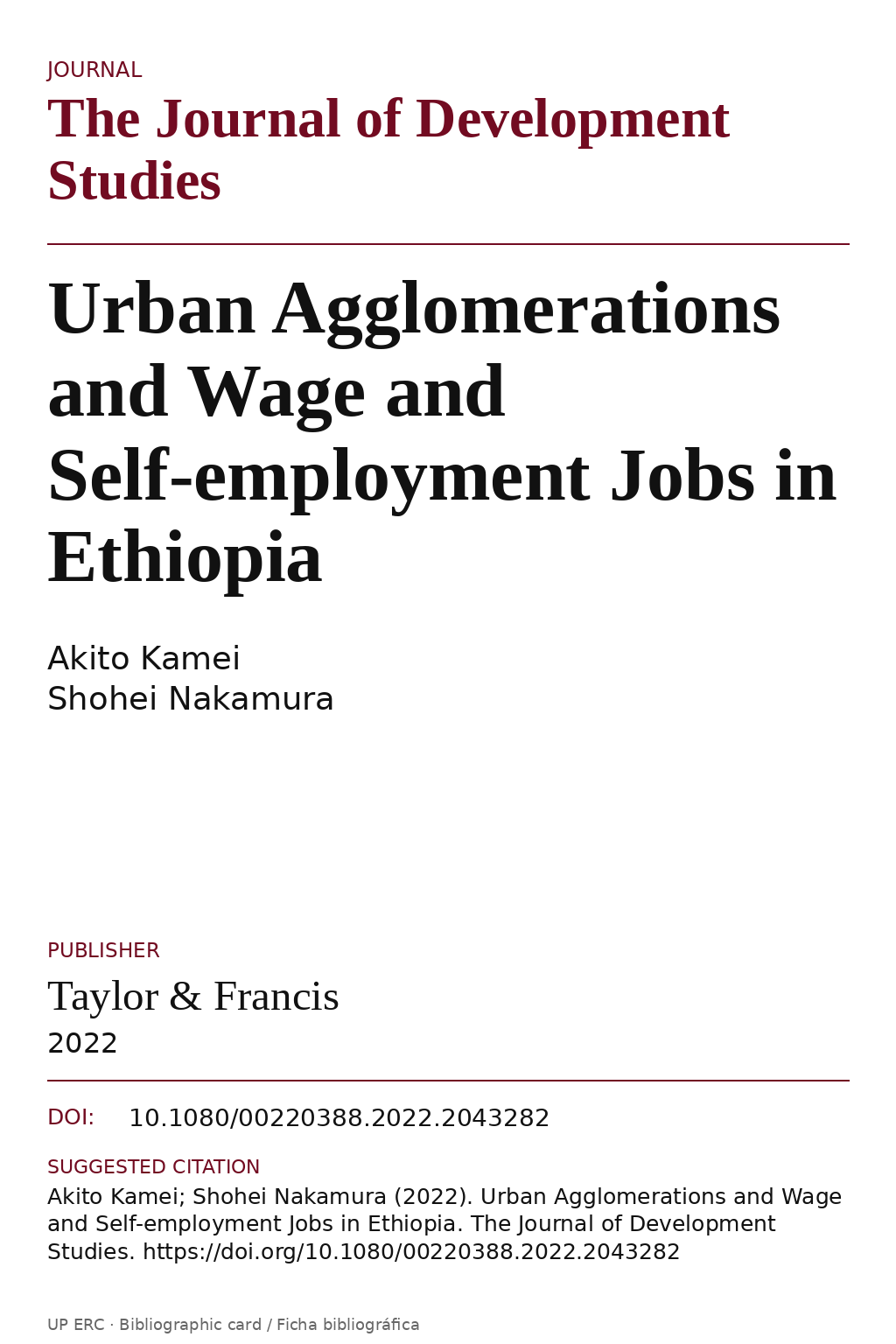
This paper studies how town size is associated with the balance between wage employment and self-employment in Ethiopia, a low-income country with a relatively low urbanization rate. Using cross-sectional worker-level data and an instrumental-variable strategy, it examines whether urban agglomeration is linked to workers’ employment mode. The estimates indicate that a logarithmic increase in town population lowers the probability of self-employment by 7.9 percentage points. The relationship is especially pronounced for women, younger workers, and people with less education, who are more likely to hold wage jobs in larger towns. The findings point to a link between urban concentration and the transformation of work, complementing evidence on agglomeration and productivity that has largely focused on developed economies.

UP researcher: Akito Kamei
with Shohei Nakamura

The Journal of Development Studies · 2022

Read paper ↗

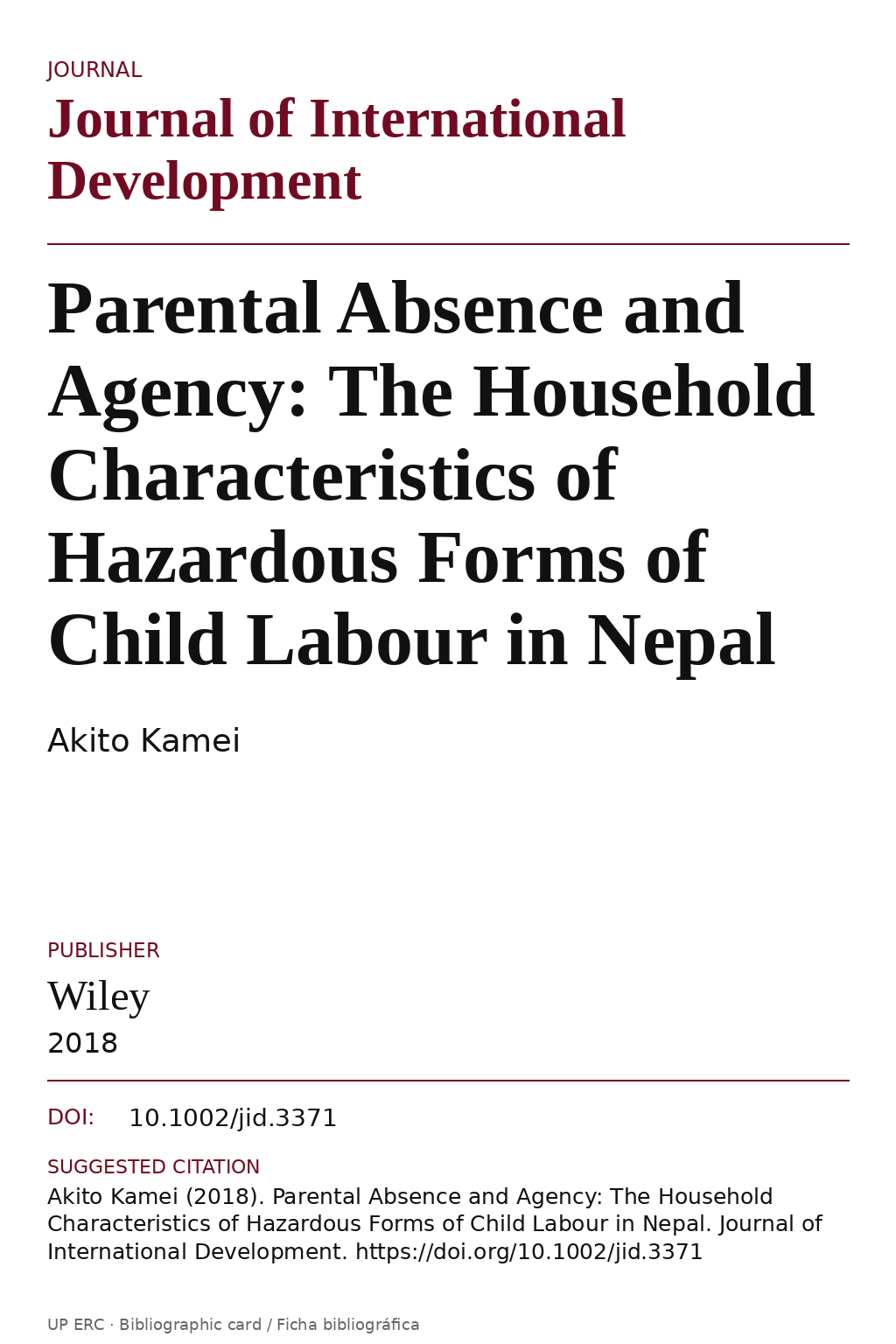
Using Nepal’s 2014 Multiple Indicator Cluster Survey, which includes information on children’s working conditions, this paper investigates household factors associated with hazardous child labour. The analysis focuses on children already engaged in work and asks which circumstances are linked to greater exposure to dangerous forms of labour. Children from poorer households face a higher risk of hazardous work. A father’s absence due to death and living without parental care are also associated with increased risk. The results provide evidence on how household circumstances and care arrangements relate to children’s working conditions, helping identify families who may need targeted protection. The study emphasizes that policies to eliminate hazardous child labour should account for poverty and the availability of parental care.

UP researcher: Akito Kamei

Journal of International Development · 2018

Read paper ↗