

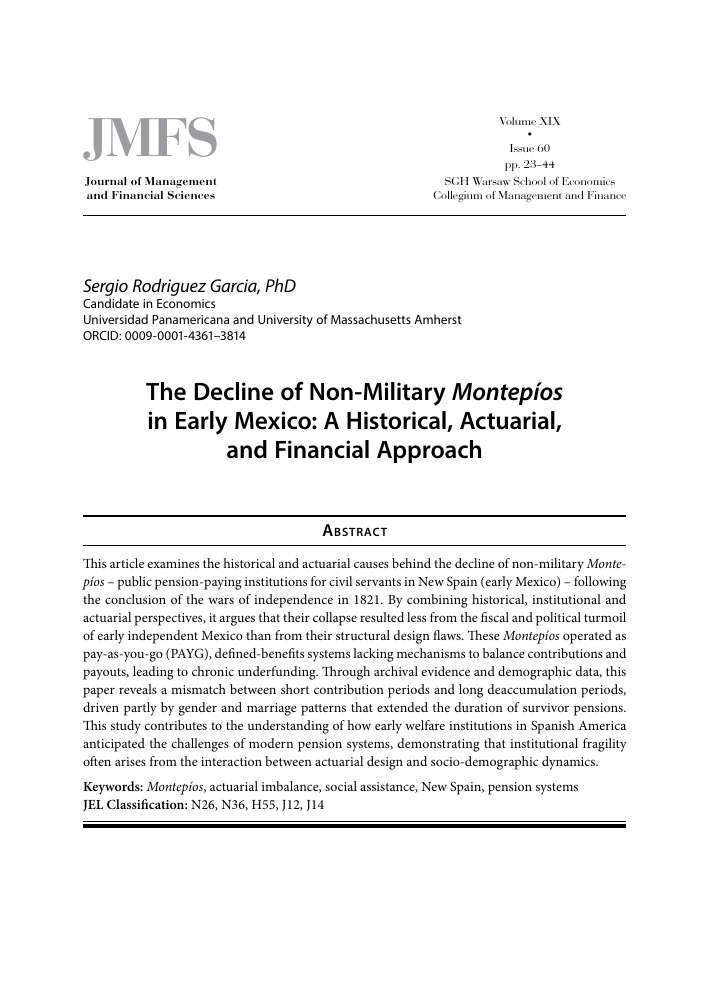
Why did some of Mexico’s earliest public pension institutions fail? This article examines the decline of non-military Montepíos—pension-paying institutions for civil servants in New Spain and early independent Mexico—after 1821. Rather than viewing their collapse mainly as a consequence of the political and fiscal turmoil that followed independence, the article argues that weaknesses in the pension systems’ own design were central. These Montepíos operated largely on a pay-as-you-go basis, using current contributions to finance current benefits, but they lacked mechanisms to keep contributions and future obligations in balance. Drawing on archival records and demographic evidence, the article shows that contributors often paid into the system for relatively short periods while pensions, especially survivor pensions, could continue for many years. Gender and marriage patterns further extended these payment periods. The findings show that problems commonly associated with modern pension systems—underfunding, demographic pressure, and a mismatch between contributions and benefits—were already present in early welfare institutions in Spanish America.
Journal of Management and Financial Sciences · 2026