



Research area

Digital and Business Economics

Close-up of electronic circuits and components on a computer motherboard.

Digital technologies and business innovation are transforming the way individuals work, communicate, learn, and access economic opportunities. Advances in artificial intelligence, fintech, digital platforms, and data-driven decision making are reshaping industries and labor markets worldwide, while also creating new challenges related to inequality, productivity, ethics, regulation, and access to technology.

This research agenda examines how technological change and business innovation affect organizations, labor markets, financial systems, and economic development. Current projects explore topics such as digital transformation, financial technology (fintech), artificial intelligence, organizational ethics, gender inclusion in leadership, and the role of technology and innovation in promoting inclusive and sustainable economic growth.

Team

Current Projects

Impact of Government Digitalization on Business: Evidence from Estonia's Digital Transformation

As governments worldwide invest heavily in e-government infrastructure, a critical empirical question is whether digital public administration translates into measurable gains for firms and the broader economy. Using synthetic control methods, this project evaluates Estonia's landmark digitalization reforms — including the X-Road interoperability platform launched in the early 2000s — against a carefully constructed counterfactual of comparable transition and European economies. The analysis examines the causal effect of digital government on corruption control, drawing on World Bank Governance Indicators spanning the full post-independence period.


UP Researchers: Eugenio Gómez, Esteban Colla, and Marytell A. Castellanos

Digital display spelling Estonia.

Bridging the Fintech Gap: Regulatory Frictions and Active Financial Inclusion in an Emerging Economy

As digital financial infrastructure expands across emerging markets, a critical question remains unresolved: under what conditions does fintech development translate into spcially impactful financial inclusion rather than mere formal access? This study examines Mexico's fintech ecosystem — one of Latin America's largest and most dynamic — through the lens of a structural paradox: advanced regulatory and technological infrastructure coexisting with persistently low adoption rates and deep inclusion gaps. Drawing on thematic analysis of semi-structured interviews with key stakeholders across Mexico's digital financial ecosystem — including regulators, fintech entrepreneurs, incumbent financial institutions, and financial inclusion specialists — the study identifies structural frictions that explain the divergence between infrastructure development and active inclusion

UP Researchers: Eugenio Gómez, Laura Jiménez Casillas and Andrée Marie López-Fernández

Word cloud of fintech and financial inclusion terms.

Publications

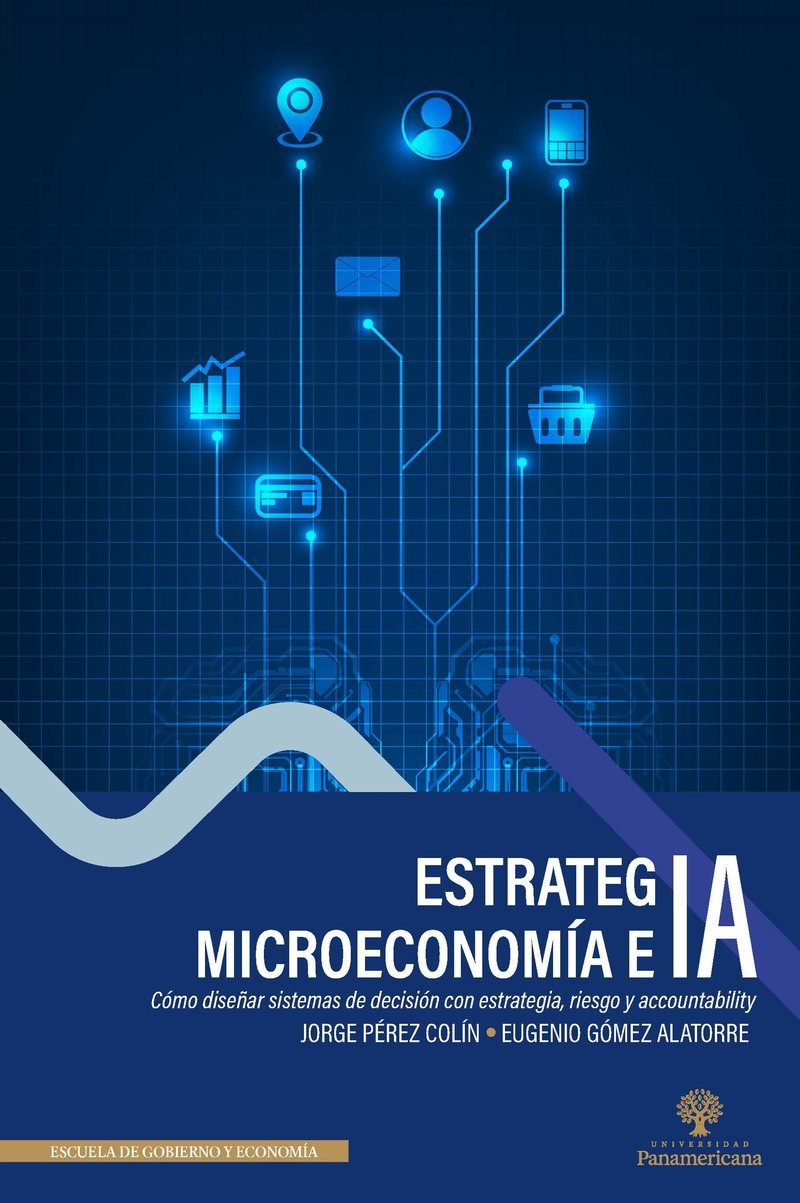
This book examines how microeconomic reasoning can guide organizational decisions carried out by algorithms and AI. It connects strategy, incentives, risk, traceability and accountability in the design of decision systems for pricing, resource allocation and competition.

UP researcher: Eugenio Gómez Alatorre
with Jorge Pérez Colín

Primera edición electrónica · 2026

View publication ↗

This teaching case follows VelaFi, a Mexico-based financial-technology startup offering cross-border payments using stablecoins, as it faces competition from large, well-funded firms. Its chief executive must decide how the company can defend a position after the business model has demonstrated the potential to make transfers faster and less costly than traditional correspondent banking. The case frames strategic options such as specializing in international payroll or global treasury services, serving underserved Latin American small and medium-sized businesses, or differentiating through service. It is designed for students to analyze technology-driven disruption in emerging-market financial services, stablecoins and monetary concepts, competitive strategy, and the role of regulation. It presents a decision problem for classroom discussion rather than a research study with empirical findings.

UP researcher: Eugenio Gomez-Alatorre

Emerald Emerging Markets Case Studies · 2026

Read paper ↗

This study evaluates how organizations can communicate a code of ethics and whether explaining the code improves employees’ understanding. The authors conduct a cluster-randomized controlled trial with 519 workers at a prominent Mexican pawnshop chain, comparing communication and explanation approaches against the existing program. They find no evidence that the interventions enhanced workers’ understanding of the code. The result raises the possibility that ethics programs based mainly on distributing or explaining a written code may fail to achieve their intended purpose and may use resources without changing employee comprehension. The paper also demonstrates that a cluster-randomized trial can be implemented in the business-ethics setting, providing a rigorous approach for evaluating organizational ethics initiatives and informing the design of more effective programs.

UP researcher: Eugenio Gómez-Alatorre
with Juncal Cuñado, Ignacio Ferrero

Business and Society Review · 2022

Read paper ↗

This study proposes a vignette-based field experiment in Mexico to examine whether decision-makers assess executive candidates differently according to sex, marital status, and parenthood. Participants evaluate fictitious résumés in which these characteristics are varied, allowing the study to isolate how personal attributes may influence judgments of candidates for senior-management positions. The project aims to identify discriminatory patterns in talent selection and compare them with evidence and theories from the economics of discrimination and personnel selection. Its intended contribution is to provide evidence about potential bias in executive recruitment, a setting that has received less attention than hiring for other occupations, and to inform efforts to make selection processes fairer. This record describes a conference-stage study proposal rather than reporting completed experimental results.

UP researcher: Eugenio Gómez-Alatorre
with Yvette Mucharraz y Cano

Academy of Management Global Proceedings, Mexico · 2020

Read paper ↗